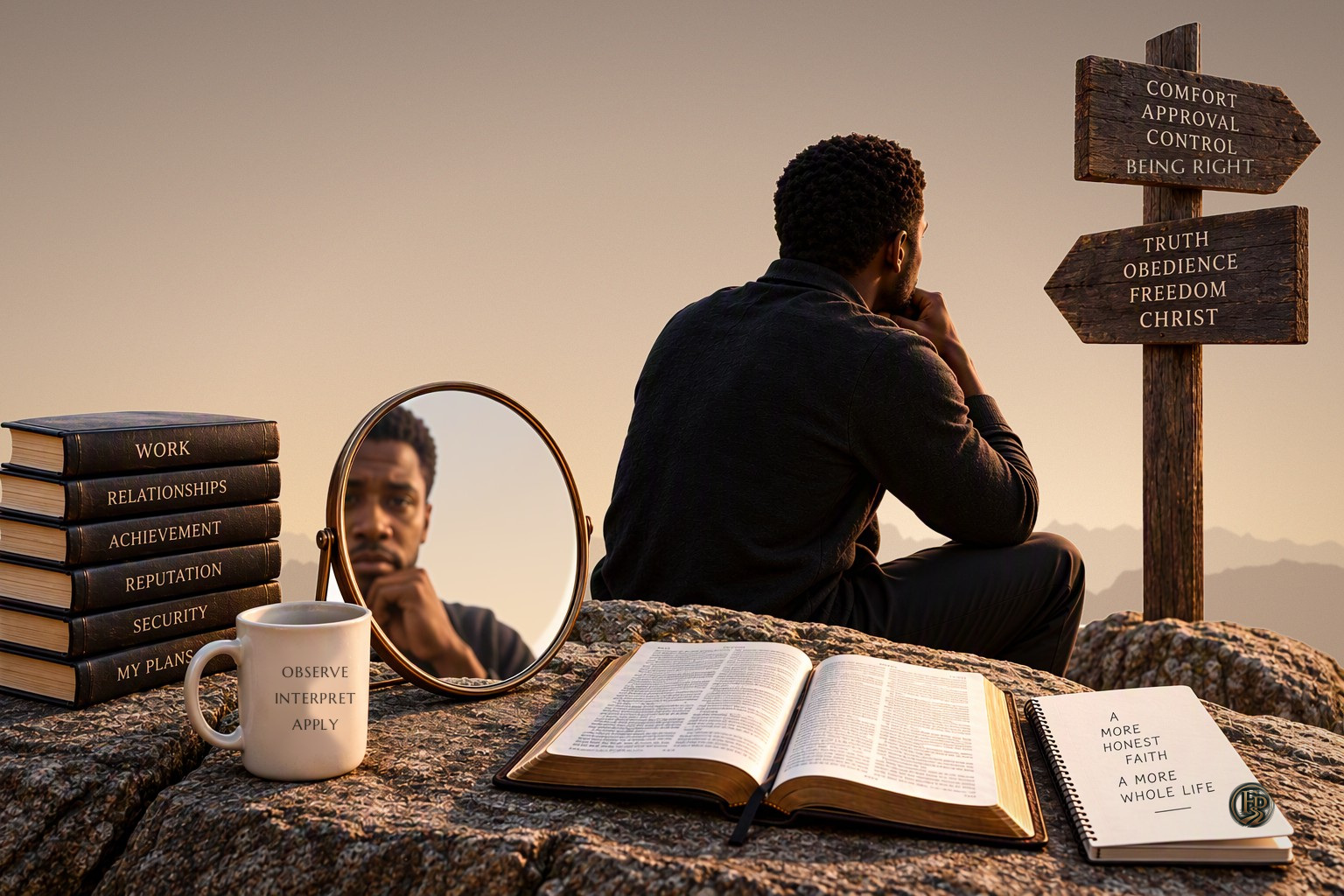
What if your greatest certainty is your greatest deception? The question reaches beyond what we say we believe. It asks whether the trust directing our ordinary choices can bear the weight we have placed upon it.
Thank you for reading. If this spoke to you, subscribe to the Formative Letters for new reflections.
“What good will it be for someone to gain the whole world, yet forfeit their soul?”— Matthew 16:26, NIV
Someone you trust asks why you keep accepting work that leaves you with so little time for the people you love. You answer before they have finished: “I am doing this for my family.”
There may be truth in that. Yet the speed of your defence leaves another question unexplored. How much of this is provision, and how much is the fear of becoming less important if you slow down?
A belief can sound responsible while shielding something we would rather not examine. Once it becomes familiar, we may stop noticing how much authority it has acquired. It decides what we pursue, what we excuse, and which questions we refuse to hear.
This is why certainty deserves attention. What we trust is already forming us, whether we chose it carefully or not.
The beliefs we stop examining
Some convictions reach us through family or church. Others develop through disappointment, achievement, or the effort to feel safe. Over time, a conclusion such as “I must remain useful to be loved” can become so ordinary that we treat it as fact rather than belief.
We then organise life around it. We say yes when we need to say no. We hide a struggle because being needed feels safer than needing help. When someone questions the pattern, we hear a threat to our worth.
Sincerity cannot tell us whether such a conviction is true. Neither can the number of years we have lived by it. “There is a way that appears to be right, but in the end it leads to death” (Proverbs 14:12). Our judgement can fail precisely where we feel most assured.
That warning belongs inside the church as well. Familiarity with Christian language does not make every assumption beneath it Christian. We may speak of trusting God while relying on approval, control, or an expectation that obedience should protect us from hardship.
How certainty deceives
When Scripture speaks of deception, it rarely means a clever lie someone else tells us. More often it describes a story we prefer to tell ourselves. “The heart is deceitful above all things” (Jeremiah 17:9). “Do not merely listen to the word, and so deceive yourselves” (James 1:22). “If we claim to be without sin, we deceive ourselves” (1 John 1:8). In each case, we are participants in our own deception.
Psychology describes the same pattern from another angle. In counselling, the deep conclusions we hold about ourselves are often called core beliefs: they filter experience before we have consciously thought about it. Researchers also describe confirmation bias, our tendency to notice, remember, and favour whatever supports what we already believe, and to pass quickly over what challenges it. A certainty does not need to be true to feel confirmed every day.
So the useful question is not, “How sure am I?” but, “How does this belief behave when it is questioned?”
| Healthy conviction | Defensive certainty |
|---|---|
| Can hear a question | Hears a question as an attack |
| Rests on evidence and, finally, on Christ | Rests on how long it has been held |
| Grows clearer when corrected | Grows louder when challenged |
| Can say, “I may be wrong about this” | Needs others to agree |
| Leaves room for repentance | Leaves room only for defence |
When good things carry too much
Work, relationships, and achievement can be genuine gifts. Disappointment does not make them worthless. The difficulty begins when we ask them to provide what they cannot guarantee.
A career can offer useful work and an income. It cannot establish our worth before God. A relationship can offer love and companionship. It cannot remove every uncertainty or make another person responsible for our whole security. Even a respected place in a church can become something we protect at the expense of honesty.
Often the hidden promise sounds reasonable: once I reach this position, I will be at peace; if this person stays, I will know I matter. Because the promise is rarely spoken aloud, it is rarely tested. We keep making sacrifices for it without asking whether it can be fulfilled.
Right and wrong in the same breath
Jesus’ question about gaining the world was not spoken into a vacuum. It came minutes after one of His closest friends had been both completely right and completely wrong.
At Caesarea Philippi, Jesus asks His disciples who they say He is. Peter answers, “You are the Messiah, the Son of the living God” (Matthew 16:16), and Jesus calls him blessed: this truth was revealed to him by the Father. Then Jesus begins to explain that He must suffer, be killed, and be raised to life. Peter takes Him aside, with the same conviction, and rebukes Him: “Never, Lord! This shall never happen to you!” (16:22).
“Get behind me, Satan! You are a stumbling block to me; you do not have in mind the concerns of God, but merely human concerns.”— Matthew 16:23, NIV
This is the heart of the matter. Revealed truth and a self-protective certainty lived in the same man, a few verses apart, and the false one felt every bit as sure as the true one. Peter’s certainty was not malicious. It was loyal, sincere, even loving. It was also standing in the way of the cross.
Only then does Jesus call His disciples to deny themselves, take up their cross, and follow Him, and ask what it would profit them to gain the whole world and forfeit their soul (16:24–26). The challenge reaches further than wealth. We can protect a reputation by concealing the truth, preserve our comfort by avoiding a necessary act of obedience, or secure acceptance by remaining silent when we ought to speak. Each decision may appear to work. Yet each one also shapes the kind of person we are becoming.
The same certainty surfaced again on the night of Jesus’ arrest: “Even if all fall away on account of you, I never will” (Matthew 26:33). Within hours, Peter had denied Him three times. Like him, we do not have to wait until the end of life to begin forfeiting what matters. The habits through which we protect ourselves deserve examination now, while there is still opportunity to repent.
Honest examination should not become endless suspicion of every thought. Its purpose is to make us receptive to correction. We need enough humility to ask whether the life we are defending is the life Christ is calling us to live.
Certain of whom?
A fair reader may object at this point. If we are meant to question our certainties, why should we be certain about Jesus? The objection deserves a direct answer. The failure of our securities does not, by itself, prove the Christian faith. Nor does a claim become true because it is spoken with confidence. If we challenge unexamined beliefs in others, we must be willing to examine our own.
The Christian invitation is to attend to Jesus Himself. In John 14, He addresses troubled disciples, and Thomas admits that he does not know the way. Jesus answers:
“I am the way and the truth and the life. No one comes to the Father except through me.”— John 14:6, NIV
This is a claim about who Jesus is and about our access to the Father. It asks for more than admiration. To take it seriously is to examine His life and teaching, and the apostolic witness to His death and resurrection. Paul makes the resurrection decisive: if Christ has not been raised, our faith is futile (1 Corinthians 15:17). Christianity does not ask for blind confidence. It places a Person and a history before us to examine. (For more on this, see why truth is found in Christ.)
Notice how Paul describes his own confidence near the end of his life: “I know whom I have believed, and am convinced that he is able to guard what I have entrusted to him” (2 Timothy 1:12). Not what, but whom. Christian certainty rests on a Person, not on our grasp of every question. That is why it can be firm and humble at the same time.
For the believer, trust in Christ also brings our interpretations under scrutiny. We can trust Him while admitting that we have misunderstood a passage, defended an unhealthy habit, or mistaken personal preference for His will. Receiving correction need not threaten our belonging to Him.
Grace makes such honesty possible. We can confess that we have been wrong without first proving that we deserve to be received. The Christ who calls us to repentance is also the One to whom we come for forgiveness. As we learn to trust Him, we become freer to let go of the certainties we have used to protect ourselves.
The Formative Practice
Observe · Interpret · Apply
Choose one belief that has been directing your decisions, and give it a week of careful attention. The aim is not to doubt everything, but to bring one real pattern into the light and respond faithfully. Each step looks two ways: at your heart, and at the Word.
Step 1Observe
Your heart
Recall a recent moment when you became unusually defensive or afraid of losing something. Write down what happened and the thought that followed. Then complete this sentence: “If I lose this, it will mean…”
The Word
Read Matthew 16:13–26 slowly. Notice what Peter gets right, what he gets wrong, and how quickly one follows the other.
Where they meet: Keep your first observations separate from the explanation you usually give yourself. You cannot examine a belief you are still defending.
Step 2Interpret
Your heart
Ask what your thought assumes about your worth, your safety, or God. Hold it against the comparison above: does it behave like a healthy conviction or a defensive certainty?
The Word
Read John 14:1–7 in context. Consider what Jesus actually promises, and what you may have added to His promise.
Where they meet: Talk through what you notice with a mature Christian who can question you kindly and honestly. Some blind spots are only visible to someone standing beside us.
Step 3Apply
Your heart
Choose one action that puts your revised understanding into practice. If being indispensable has governed your choices, let someone else carry a responsibility you would normally seize. If protecting your reputation has kept you from admitting a mistake, acknowledge it and put it right. Write down what you fear will happen.
The Word
Before you act, pray Psalm 139:23–24: “Search me, God, and know my heart; test me and know my anxious thoughts.”
Where they meet: At the end of the week, compare what you feared with what actually happened, and ask what God has shown you through the difference.
Your week
- Days 1–2 · Notice. Watch for moments of sudden defensiveness. Write down what happened and the thought beneath it.
- Day 3 · Read. Matthew 16:13–26 and John 14:1–7. Note one phrase from each that speaks to your belief.
- Day 4 · Talk. Share what you have noticed with a trusted, mature Christian, and invite honest questions.
- Days 5–6 · Act. Take your one step of obedience, praying Psalm 139:23–24 before you begin.
- Day 7 · Review. What did you fear? What actually happened? What do you now understand differently?
For small groups
- Peter was sincere and wrong in the same breath. Where have you seen good intentions protect a wrong conclusion?
- Which row of the comparison table do you find most uncomfortable, and why?
- What makes it safe, or unsafe, to admit “I may be wrong” in our church or group?
A confidence that can receive correction
Peter’s story does not end in denial. Beside the lake after the resurrection, Jesus asks him three times, “Do you love me?” This time Peter makes no promise about what he will never do. He says, “Lord, you know all things; you know that I love you” (John 21:17). His confidence has moved from himself to Christ. That is the journey this article invites you to make.
Return to the conversation about work and family. You may still need to work hard. But perhaps you can now listen without rushing to defend yourself. Perhaps you can admit that a good responsibility has become entangled with a fear you have never named. That admission gives you somewhere honest to begin.
The question “What if I am wrong?” can become a prayerful opening for change. Bring it to Christ with a willingness to be taught. Read His words carefully. Let trusted people speak. Follow through on the obedience you already understand.
You do not have to preserve every certainty you have carried. You can entrust yourself to Christ and allow Him to correct what you have mistaken for truth.
Faith that can receive correction is not weaker faith. It is faith that rests on Christ rather than on being right.
Scripture quotations taken from The Holy Bible, New International Version® NIV®. Copyright © 1973, 1978, 1984, 2011 by Biblica, Inc.™ Used by permission. All rights reserved worldwide.