
Faith is easy to profess when little is at stake. Its deeper character emerges when obedience becomes costly: when remaining faithful to God threatens our comfort, reputation, ambitions, security, relationships, or even our lives. In those moments, faith moves beyond confession and becomes formation.
Thank you for reading. If this spoke to you, subscribe to the Formative Letters for new reflections.
“If this be so, our God whom we serve is able to deliver us from the burning fiery furnace, and he will deliver us out of your hand, O king. But if not, be it known to you, O king, that we will not serve your gods or worship the golden image that you have set up.”— Daniel 3:17–18, ESV
The question is no longer simply, What do I believe? It becomes, What will I remain faithful to when belief costs me something?
Few biblical accounts answer that question as powerfully as the story of Shadrach, Meshach, and Abednego. Theirs is not merely a story of miraculous deliverance. It is a story of convictions formed before the furnace, courage revealed in the furnace, and a faith that remained obedient without demanding a particular outcome from God: a faith that knows what it believes, knows whom it trusts, and refuses to bow.
Three Hebrews in Babylon
Shadrach, Meshach, and Abednego were young Jewish men living far from home. Taken into exile, they found themselves inside an empire determined not only to govern them but to reshape their identity. They were given new names, educated in Babylonian language and literature, and appointed to positions of responsibility. They learned to live faithfully in an unfamiliar world, serving Babylon without letting Babylon become the deepest authority over their lives.
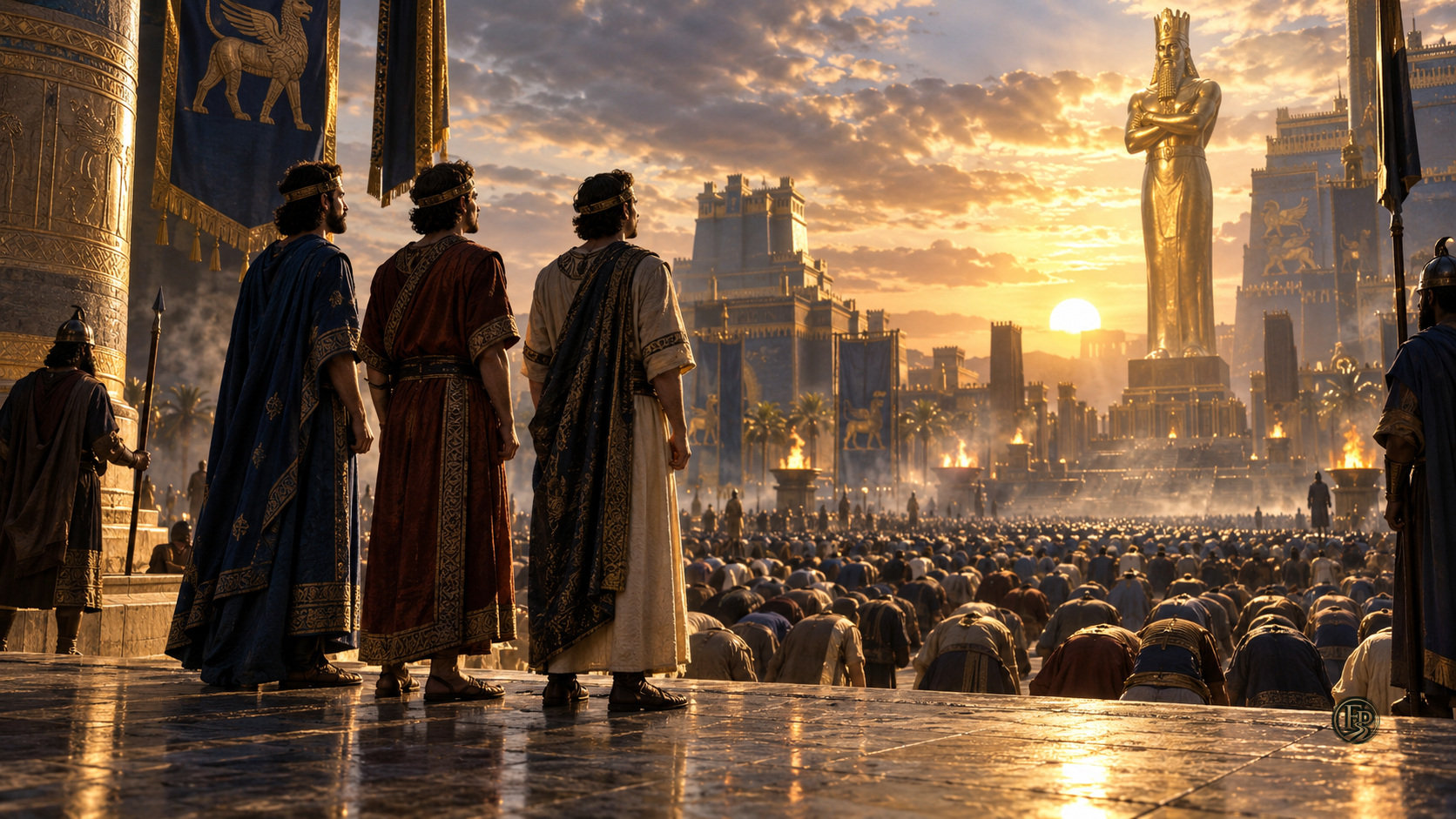
Then came the defining test. King Nebuchadnezzar erected an enormous golden image and summoned officials from across his empire to gather before it. When the music sounded, everyone was required to bow down and worship. The penalty for refusal was unmistakable: death in a blazing furnace.
The music sounded. The crowd bowed. Shadrach, Meshach, and Abednego remained standing.
Brought before the king, they were offered one more chance to comply. They did not negotiate. They did not plead for exemption. They did not soften their convictions. They declared that the God they served was able to rescue them, and that even if He did not, they would still refuse to worship the image.
They were thrown into the furnace, yet the fire did not consume them. Nebuchadnezzar looked into the flames and saw not three men but four, walking freely in the fire. The three emerged unharmed, without even the smell of fire upon them (Daniel 3:27).
The empire had demanded their worship. They gave it their witness instead.
What is asking me to bow?
Babylon was a world of power, spectacle, ambition, and enforced allegiance. The golden image was more than a statue; it was a demand: Bow, and show where your ultimate loyalty lies.
The three were not habitual troublemakers. They were capable administrators and trusted servants within the Babylonian system, and their resistance did not arise from hostility toward society. It arose from a boundary Babylon had no right to cross. They could serve the king. They could not worship what the king commanded them to worship.
Most Christians will never stand before a literal golden image, but every age develops its own forms of pressure. We may be invited to trade conviction for acceptance, silence conscience for advancement, reshape truth for approval, or surrender obedience in exchange for security. Sometimes the pressure is public. More often it is quiet: a career opportunity, the desire to be accepted, the fear of appearing different, an unwillingness to lose influence, or a small compromise that seems harmless in the moment. (If that list sounds familiar, you may also find When Certainty Becomes Deception helpful.)
One of the most striking images in Daniel 3 is the contrast between the crowd and the three. Their strength did not come from being surrounded by people who agreed with them. There are moments when faithfulness places a believer outside the comfort of consensus. That does not mean Christians should seek conflict or take pride in being different, and opposition does not automatically prove that we are right. But truth is not finally decided by popularity. Their courage had three marks:
- It was personal. No one could borrow someone else’s obedience. Each man had to remain standing.
- It was quiet. They created no spectacle. Their resistance was simple: they would not bow.
- It became visible. Convictions held in the heart are eventually expressed in decisions, habits, speech, and relationships.
The goal is not independence from others. It is a dependence upon God that stays steady even when others choose differently.
The strength of a settled heart
When Nebuchadnezzar confronted them, they replied:
“O Nebuchadnezzar, we have no need to answer you in this matter.”— Daniel 3:16, ESV
There is remarkable calm in that reply. Their decision had already been made. The furnace did not create their convictions; it revealed them. This points to an essential principle of spiritual formation: we should not wait until the moment of crisis to decide what matters most.
Character is formed beforehand. A life rooted in Scripture, prayer, worship, obedience, community, and repeated surrender develops patterns of faithfulness long before dramatic testing arrives. When pressure comes, we tend to fall back on what has already been formed within us.
That is why spiritual disciplines matter. They are not religious performances designed to earn God’s approval. They are practices through which the heart learns attentiveness, surrender, discernment, and obedience. The person who has repeatedly learned to say yes to God in ordinary life is being prepared to say yes when obedience becomes costly.
Able, wise and worthy
The heart of the story lies in their double conviction: God is able to deliver us; but if not, we will not bow. The ESV renders the second clause “But if not”; its sense, which many translations make explicit, is even if He does not.
These two convictions belong together. The three believed deeply in God’s power without presuming upon God’s decision. They knew He could deliver them. They trusted that He remained God whether or not He would deliver them in the way they hoped. And they had already settled that their obedience did not depend upon the outcome.
This is mature faith. It refuses both unbelief and entitlement. It does not say, God cannot rescue me. Neither does it say, God must rescue me in the way I demand. Instead, it says:
Here is one of the great movements of Christian formation: from transactional faith toward surrendered faith. Transactional faith says, I will trust God if He gives me the result I want. Formed faith says, I trust God because He is God.
Such faith still prays boldly. It still asks for healing, provision, deliverance, direction, and restoration. But beneath every request rests a deeper allegiance: even if the outcome is not what I hoped, I will remain Yours.
Not alone in the fire
Obedience did not keep the three out of the furnace. It led them into it.
We sometimes assume that faithfulness should make life easier, yet Scripture repeatedly challenges that expectation. Faithfulness may produce peace within us without producing ease around us. Sometimes integrity costs something. Sometimes refusing to compromise closes doors we hoped would stay open, and doing what is right leads directly into difficulty.
For Shadrach, Meshach, and Abednego, the furnace was not evidence that God had abandoned them. It became the place where His presence was revealed. Nebuchadnezzar expected to see three men dying in the flames. Instead, he exclaimed:
“But I see four men unbound, walking in the midst of the fire, and they are not hurt; and the appearance of the fourth is like a son of the gods.”— Daniel 3:25, ESV
Christians have often understood this mysterious fourth figure as a sign of divine presence, and some see in it a foreshadowing of Christ. The king’s own words are more modest: once the three emerge, he speaks of God having “sent his angel” to deliver His servants (Daniel 3:28). Whatever language we use, the central point is unmistakable: they were not alone in the fire.
That distinction transforms how we understand adversity. The deepest promise of faith is not that we will never enter difficult places, but that difficulty never places us beyond the presence of God. (For more on faith under sudden pressure, see Rocked but Unbroken.)
What the fire reveals
The furnace did something unexpected. The men went in bound; the king saw them walking unbound. What was meant to destroy them revealed them as free.
Trials often expose what comfort allows us to conceal. Pressure reveals our dependencies. Disappointment uncovers our expectations. Conflict exposes our pride. Waiting reveals our impatience. Loss shows us where we have placed our security.
Not every hardship is sent by God as a lesson, and suffering should never be romanticised. Pain is real, injustice is real, and Scripture gives believers permission to lament. Yet even in circumstances God does not delight in, He can continue His formative work. So alongside How do I get out of this? another question deserves room: What is this revealing about what has been formed within me?
The fire also made their faith public. Nebuchadnezzar intended the furnace to demonstrate his authority; instead it revealed its limits. The king who demanded worship found himself blessing the God of Shadrach, Meshach, and Abednego (Daniel 3:28). Transformation is personal, but it is never merely private. People notice how we respond to pressure, whether our values survive when compromise becomes convenient, and how we treat those who cannot advance our interests.
This does not mean performing righteousness for an audience. The three did not enter the furnace trying to impress Babylon. They entered determined to honour God, and the witness followed.
The Formative Practice
Observe · Interpret · Apply
Daniel 3 becomes formative when it moves from admiration to practice. We are not called merely to celebrate the courage of three young men, but to become people capable of the same faithfulness. Each step looks two ways: at your heart, and at the Word.
Step 1Observe
Your heart
Notice where you feel pressure to compromise: at work, in a relationship, online, or in church. Ask honestly: Where am I most vulnerable? What do I fear losing? Write down the one “golden image” that pulls at you most.
The Word
Read Daniel 3:1–18 slowly. Notice what the three say, and what they do not say: no bargaining, no pleading for exemption, no softening.
Where they meet: Name the pressure plainly, without excusing it or exaggerating it. You cannot resist what you have not yet recognised.
Step 2Interpret
Your heart
Ask whether your faithfulness has quietly become conditional. Where are you holding God to a particular outcome, so that your obedience depends on the result?
The Word
Sit with Daniel 3:17–18. Notice how “God is able” and “but if not” stand side by side, neither cancelling the other.
Where they meet: Pray boldly for what you hope for. Then write your own “even if” sentence: God can. I pray that He will. But even if He does not, I will remain faithful.
Step 3Apply
Your heart
Choose one ordinary act of obedience this week. Speak truth when exaggeration would benefit you. Keep your word when breaking it would be easier. Forgive when resentment feels justified. Stand firmly, but without becoming harsh.
The Word
Read Daniel 3:24–28. Notice where God is found: not outside the furnace, but within it.
Where they meet: When hardship comes, ask not only, Why am I here? but also, How might I become more aware of God’s presence here?
Your week
- Days 1–2 · Notice. Watch for moments when you feel pressure to bow. Write down what pressed on you and what you feared losing.
- Day 3 · Read. Daniel 3 in full. Mark verse 16, verses 17–18 and verse 25.
- Day 4 · Write. Your own “even if” sentence, naming the outcome you are tempted to make a condition of your obedience.
- Days 5–6 · Practise. Your one act of ordinary obedience. Do it quietly, firmly and kindly.
- Day 7 · Review. What did you fear? What happened? Where did you notice God’s presence?
For small groups
- The three served Babylon faithfully but would not worship its gods. Where is the line between serving our culture and bowing to it?
- Why do you think their reply to the king was so calm? What forms that kind of settledness?
- Share an “even if” you are living with, or one you are struggling to say.
The “even if” life
There is a kind of faith that depends on favourable conditions. And there is another kind, a faith that has travelled deeper. It can pray for deliverance without making deliverance the condition of devotion. It believes that God is powerful enough to rescue, and worthy enough to obey even when rescue does not come in the form we desire.
Even if the door does not open.
Even if the answer is delayed.
Even if obedience costs me.
Even if others misunderstand.
Even if I lose what I hoped to keep.
Even if the furnace remains hot.
I will not bow.
Not because I am fearless. Not because I am stronger than everyone else. Not because the outcome is guaranteed. But because God remains God.
Spiritual formation rarely happens in moments of public heroism. It happens in the accumulated decisions of ordinary faithfulness: conviction becoming practice, practice becoming character, character becoming courage, courage becoming witness. By the time Shadrach, Meshach, and Abednego stood before Nebuchadnezzar, the deepest work had already taken place. Their allegiance had been settled. The furnace simply revealed it.
A world that continually invites compromise needs believers who have been deeply formed: people who can live faithfully within their culture without surrendering themselves to it, and who know when to take part, when to resist, when to speak, and when simply to remain standing.
And when the music plays and the pressure to bow grows strong, may what has been formed within us become visible. May we trust God’s power, surrender to His wisdom, and remain aware of His presence. And may our lives quietly declare: even if He does not, we will not bow.
Scripture quotations are from the ESV® Bible (The Holy Bible, English Standard Version®), © 2001 by Crossway, a publishing ministry of Good News Publishers. Used by permission. All rights reserved.