
We often imagine change beginning with a decisive moment: a new year arrives, a relationship ends, a conversation unsettles us, or we finally tire of repeating the same pattern.
Thank you for reading. If this spoke to you, subscribe to the Formative Letters for new reflections.
We make a promise, draw up a plan, and feel energised by the possibility of becoming different. Then ordinary life returns. Energy fades, old pressures reappear, and familiar reactions take over. Before long, the future we imagined has been overtaken by the life we already knew.
When this happens, we usually blame motivation. We assume that we were not disciplined, committed, or determined enough. Yet motivation may not be the real problem.
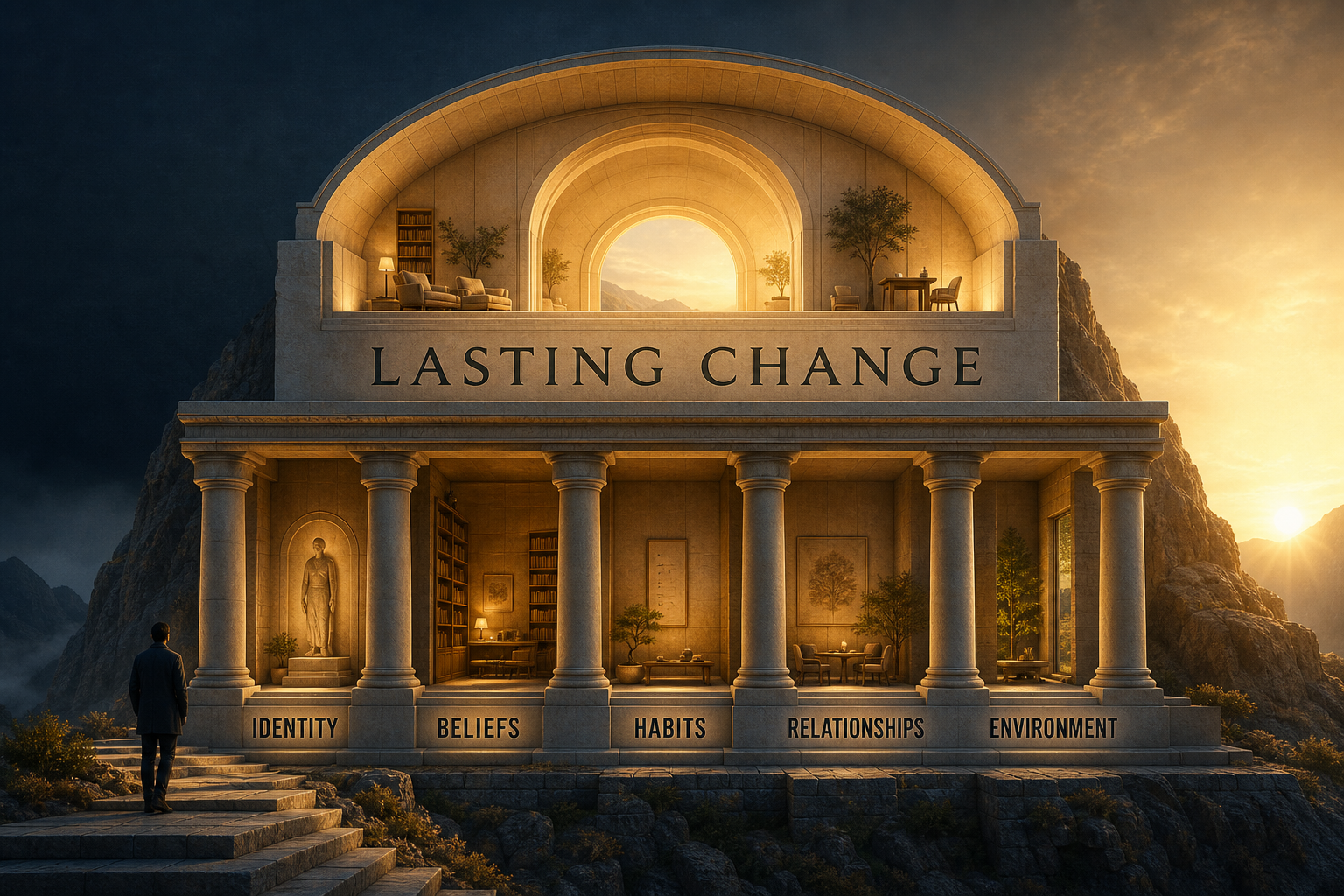
A building does not stand because its architect felt inspired. It stands because careful attention was given to what lies beneath the surface: foundations, load-bearing walls, structural alignment, materials, and environment. Human transformation works in much the same way.
Lasting change is not primarily an act of willpower. It is the visible result of an inner architecture built with intention.
Beneath every repeated action lies a network of identity, beliefs, habits, relationships, bodily patterns, and environment. If that structure remains unchanged, even sincere resolutions will eventually bend back towards the familiar.
Change Begins Beneath the Surface
When a building develops cracks, repainting the wall may improve its appearance, but it will not correct movement in the foundation. Many attempts at personal change are forms of repainting. We alter a behaviour without examining the identity beneath it. We begin a routine while protecting the belief that undermines it. We pursue an ambitious goal while remaining surrounded by cues and relationships that pull us in the opposite direction.
Behaviour matters, but behaviour is also a messenger. Procrastination may reveal fear of failure. Constant activity may conceal anxiety about worth. Withdrawal may have begun as protection from disappointment. If we condemn the behaviour without listening to what it is protecting, we may remove a coping strategy without healing the wound beneath it.
Christian formation invites a deeper honesty. Grace allows us to look beneath the surface without treating every weakness as a final verdict. God does not merely demand improved appearances; he forms people whose inner lives can carry the weight of love, responsibility, and calling.
Identity and Beliefs: The Foundation and the Windows
Every meaningful change begins with a question deeper than “What should I do?” It begins with: Who am I becoming?
Identity is the story we carry about who we are, what we deserve, what we can become, and where we belong. Someone who believes, “I always give up,” interprets a setback as proof. Someone who understands themselves as a growing and responsible person can interpret the same setback as instruction. The event is unchanged; the identity through which it is understood is different.
Our beliefs then act like windows. We encounter life through assumptions about God, ourselves, other people, success, suffering, rest, and risk. A person may desire a healthy relationship while believing that vulnerability always leads to rejection. Another may long for rest while secretly believing that stopping is laziness. The stated goal and the hidden belief work against one another.
Paul’s invitation to “be transformed by the renewing of your mind” (Romans 12:2) places renewal before transformation. This is not positive thinking or denial. It is the patient work of bringing falsehood into the light, returning to truth, and practising a more faithful interpretation.
Habits and the Body: Where Intention Becomes Concrete
We are shaped not only by what we believe, but by what we repeatedly practise. Habits give our convictions a body. Wanting a deeper relationship with God matters; creating unhurried space for prayer makes that longing concrete. Valuing family matters; putting the phone away at the table turns a value into lived attention.
The most formative practices are rarely spectacular. One walk does not restore physical health, one honest conversation does not repair a relationship, and one prayer does not resolve every doubt. Yet each repeated action lays another stone. Over time, practices become pathways, pathways shape character, and character influences how we meet the future.
Our bodies participate in this process. Fatigue, stress, hunger, pain, breathing, and sleep affect the choices available to us. Under pressure, the nervous system often reaches for what is familiar before the reflective mind can intervene. Lasting change therefore includes rest, movement, realistic rhythms, and compassion for human limits. The body is not an obstacle to spiritual formation; it is one of the places where formation occurs.
The goal is not a flawless routine. Perfection makes formation brittle. Choose practices small enough to repeat, meaningful enough to matter, and flexible enough to survive real life.
Relationships and Environment: The Structures Around Us
No one is formed alone. Relationships shape what feels normal, what receives encouragement, what remains unchallenged, and what becomes possible. We need more than admirers; we need companions who care not only about our comfort but about our wholeness—people who can challenge us without humiliation and support us without control.
Our surroundings are also continually suggesting what to do next. A phone beside the bed invites one kind of morning; a journal and an open Bible invite another. A crowded calendar normalises urgency. A welcoming table creates room for conversation. Digital inputs, workplace culture, media, commitments, and the emotional atmosphere of home all become part of our architecture.
Wise change works with this reality. Make the first step of a valued practice visible and easy. Add distance or friction to a repeated distraction. If your schedule contradicts your stated priorities, the calendar—not the intention—reveals the structure presently governing your life.
Putting the Structure Together
Lasting change becomes more durable when the parts of our inner architecture support one another. A renewed belief gives meaning to a habit. A repeated habit provides evidence that a different way of living is possible. Honest relationships help us remain accountable, while a well-designed environment reduces unnecessary resistance.
These elements do not need to change all at once. Begin where the structure is carrying the greatest strain. Exhaustion may require rest and clearer limits before a demanding new practice. A pattern rooted in shame may require truthful companionship or professional support before greater discipline becomes helpful. Wisdom asks not only, “What should I do?” but, “What support would make this action sustainable?”
What Setbacks Reveal
Old patterns often return under stress. Progress can be uneven, and a difficult week may expose limits that enthusiasm concealed. This does not mean the work has failed.
A setback is not a demolition order; it is an invitation to inspect the structure. What was carrying too much weight? Which belief resurfaced? Which rhythm became unsustainable? Where was support missing? What needs strengthening rather than condemnation?
Grace enables honest inspection without confusing conviction with shame. We can acknowledge a crack without declaring the whole structure worthless. Sometimes the most mature response is not to try harder but to revise the plan, ask for help, rest, or return to a smaller and more faithful practice.
Begin with One Faithful Stone
If you are standing at the edge of change, resist the temptation to begin with a grand promise. Begin with honest attention. Listen to the language of your identity. Examine the belief beneath a repeated reaction. Notice what your body is communicating, who influences your formation, and what your environment teaches you to value.
Then choose one foundational change: one truth to revisit, one practice to repeat, one trusted person to invite into the process, or one environmental cue to remove. Lay one stone well, then another.
Lasting change is rarely the product of one heroic decision. It is the gradual result of an inner life brought into alignment—identity, belief, practice, body, community, and environment beginning to support the same direction.
Motivation may open the door. Formation builds the house.
And when the foundation is sound, the life constructed upon it can endure.
Change becomes clearer when we recognise that we are always being formed. For personal guidance, teaching, or organisational support, contact The Formative Path.