
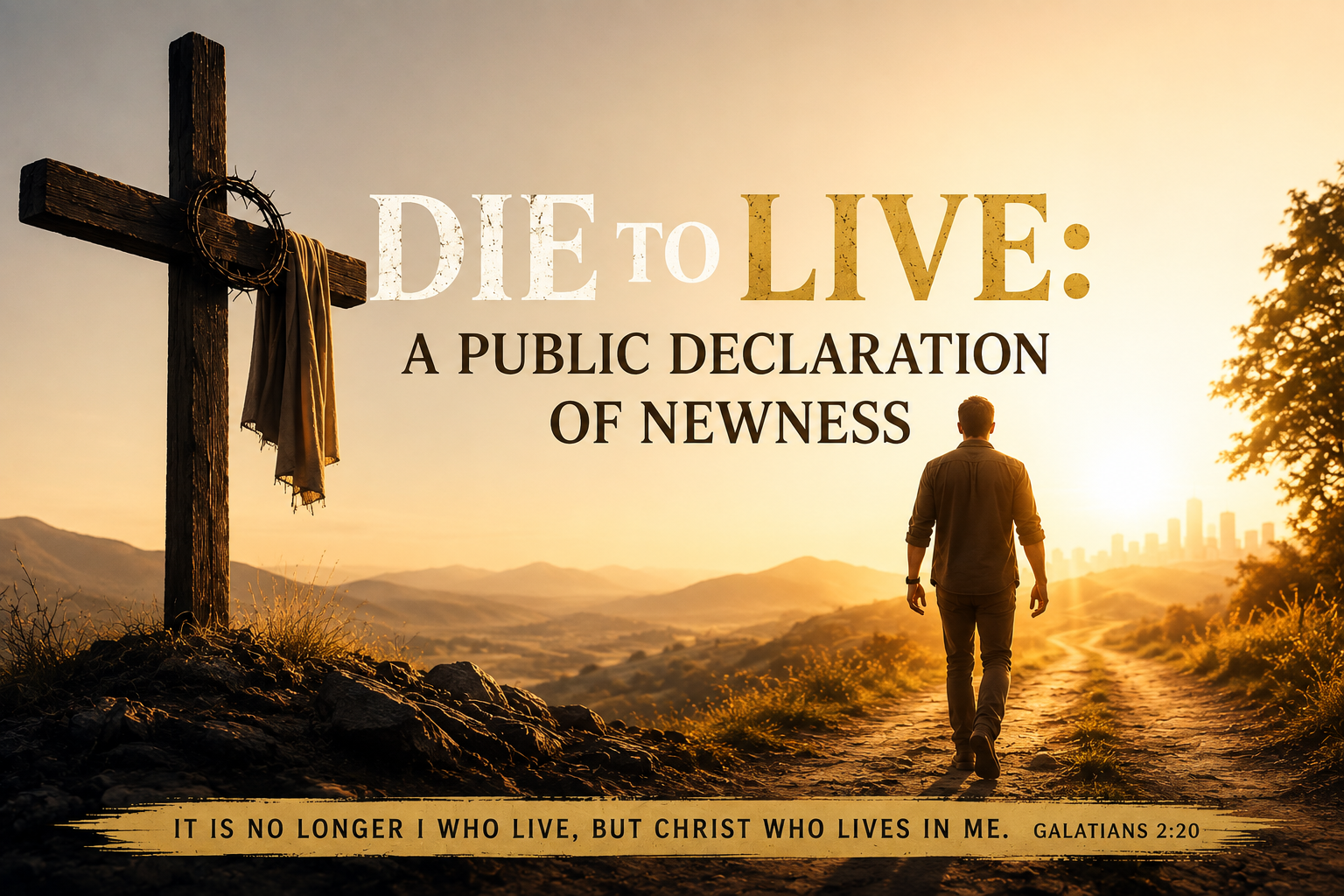
To be crucified with Christ is not a metaphor, and it is not gentle self-improvement. It is a death—and from that death rises a life that can only be explained by Christ living within us.
Thank you for reading. If this spoke to you, subscribe to the Formative Letters for new reflections.
“I have been crucified with Christ, and I no longer live, but Christ lives in me. The life I now live in the body, I live by faith in the Son of God.”
There are verses in Scripture that do not whisper; they announce. Galatians 2:20 is one of them. Paul’s words are not a quiet, private confession murmured in the corner of a synagogue. They are a public proclamation of death and life, of an identity surrendered and an identity received. When Paul says, “I have been crucified with Christ,” he is not speaking loosely. He is announcing that the man they once knew—Saul of Tarsus, persecutor of the Church, defender of tradition, enemy of grace—has died. Crucified. Finished.
In his place stands a new man, shaped not by zeal without knowledge but by union with Christ. Paul’s transformation was not subtle. It was not cosmetic. It was not a gentle shift in personality. It was a death, and from that death emerged a life explained only by Christ living in him.
But what does it truly mean to be crucified with Jesus? What does it mean to be transformed into his likeness? And how does this death reshape the way we live—publicly, daily, and faithfully?
Crucified with Christ: The End of the Old Self
To be crucified with Christ is to undergo a decisive break with the old life. Crucifixion is not partial. It is not symbolic. It is not reversible. It is final.
When Paul says, “I no longer live,” he describes a spiritual reality with practical consequences. The old self—its desires, its patterns, its loyalties, its habits—has been nailed to the Cross. Crucifixion is not comfortable. It is not convenient. It is not a gentle invitation to self-improvement. It is death.
1. The death of the old identity
Paul’s former identity was built on achievement, pedigree, religious performance, and personal zeal. Yet after encountering Christ, he realised that none of these things could produce righteousness. They could only produce pride.
To be crucified with Christ means that the identity we once built for ourselves—through culture, family, ambition, fear, or sin—no longer defines us. We die to the version of ourselves shaped by the world and are raised into the version shaped by Christ.
2. The death of old patterns
The Cross is not only where Jesus died; it is where our old patterns die. The habits that once governed us lose their authority. The addictions that once held us lose their grip. The emotional cycles that once controlled us lose their power.
This does not mean the old patterns vanish instantly. It means they no longer reign. Their rule has ended, their authority has been broken, and their voice has been silenced.
3. The death of self-rule
To be crucified with Christ is to surrender the throne of our lives. We no longer live for ourselves, by ourselves, or through ourselves. We live by faith in the Son of God. Our decisions, our desires, and our direction are no longer self-governed. They are Christ-governed.
Crucifixion is the end of self-rule and the beginning of Christ-rule.
Transformed into Christ’s Likeness: The Beginning of New Life
Death is not the end of the Christian story. It is the doorway. Crucifixion leads to resurrection; surrender leads to transformation. When Paul says, “Christ lives in me,” he is describing the miracle of union with Christ—the believer’s new life, new nature, and new identity.
To be transformed into Christ’s likeness is to change so profoundly that it cannot be hidden. It becomes visible in our choices, our character, our relationships, and our public witness.
1. A change from who you used to be
Christian formation is not behaviour modification. It is identity transformation. The believer does not simply become a better version of themselves; they become a new creation.
This change is not cosmetic. It is not superficial. It is not a spiritual makeover. It is a rebirth. The person who emerges from union with Christ is recognisably different. Their priorities shift. Their desires change. Their values deepen. Their habits are remade. Their inner architecture is rebuilt.
People may not understand the change, but they cannot deny it. The old you is gone. The new you is alive.
2. Self-denial: a new appetite for what nourishes the spirit
Paul’s declaration, “I no longer live,” includes a profound shift in appetite. The old self fed on spiritual junk food—empty teachings, shallow pleasures, destructive patterns, and self-centred desires. The new self hungers for what truly nourishes the spirit.
Self-denial is not self-punishment. It is the refusal to feed the flesh with what weakens the soul. It is the deliberate choice to starve the old nature and strengthen the new. In practice, this means:
- refusing spiritual junk food;
- rejecting teachings that comfort the flesh but starve the spirit;
- turning away from habits that drain spiritual vitality;
- choosing practices that cultivate Christlikeness.
Self-denial is not about deprivation; it is about formation. It is the discipline that shapes the believer into the likeness of Christ.
3. A new way of living publicly
Paul’s declaration was public because transformation is meant to be visible. The Christian life is not a private spiritual hobby. It is a public witness to Christ’s power to change a life.
To be crucified with Christ is to live in a way that others can see. They may not understand it, but they can observe it. Your speech changes. Your reactions change. Your priorities change. Your relationships change. Your decisions change. Your inner life changes. Christlikeness is not hidden; it is embodied.
The Public Nature of Newness
Paul did not hide his transformation. He announced it. He lived it. He embodied it. His newness was not a private spiritual experience; it was a public declaration of death and resurrection.
1. Newness is meant to be seen
The world does not need Christians who conceal their transformation. It needs Christians who embody it. Your newness is not for your benefit alone; it is for the world’s witness. When Christ lives in you, people should be able to see:
- a new way of thinking;
- a new way of loving;
- a new way of responding;
- a new way of suffering;
- a new way of hoping.
2. Newness is meant to be declared
Paul’s declaration was not arrogance; it was testimony. He was not boasting about his transformation; he was announcing Christ’s work in him. Your newness is a testimony of grace—a declaration that Christ has done what you could never do for yourself.
3. Newness is meant to be lived
The life you now live in the body is lived by faith. This means your daily life becomes the arena in which Christ’s life is displayed. Your workplace becomes a witness. Your home becomes a witness. Your friendships become a witness. Your decisions become a witness. Your character becomes a witness. Newness is not a moment; it is a way of life.
The Life You Now Live
Paul’s final statement is the anchor of Christian formation: “The life I now live in the body, I live by faith in the Son of God.” This means that:
- your new life is sustained by faith;
- your new identity is rooted in Christ;
- your new patterns are shaped by grace;
- your new direction is guided by the Spirit;
- your new strength comes from union with Christ.
You do not live the Christian life by willpower; you live it by Christ’s power. You do not sustain your own transformation; Christ sustains it. You do not manufacture Christlikeness; Christ forms it within you.
The life you now live is not your life improved; it is Christ’s life expressed through you.
The Paradox: Die to Live
To be crucified with Christ is to die. To be united with Christ is to live. This is the paradox at the centre of Christian formation: death produces life, surrender produces strength, and crucifixion produces resurrection.
Paul’s declaration is also your invitation—to let the old self be nailed to the Cross, and to let Christ live in you.
This surrender of the throne is the same movement explored in The Principle of Obedience: the willingness to release what quietly rules us, so that grace can reach the very centre of our lives.